Claude Mythos 5 Redesigns Quantum Circuits, Cutting Gate Costs Up to
Anthropic reported that Claude Mythos 5 autonomously redesigned eight quantum computing primitives, beating published circuits on seven tasks and slashing
By AI World
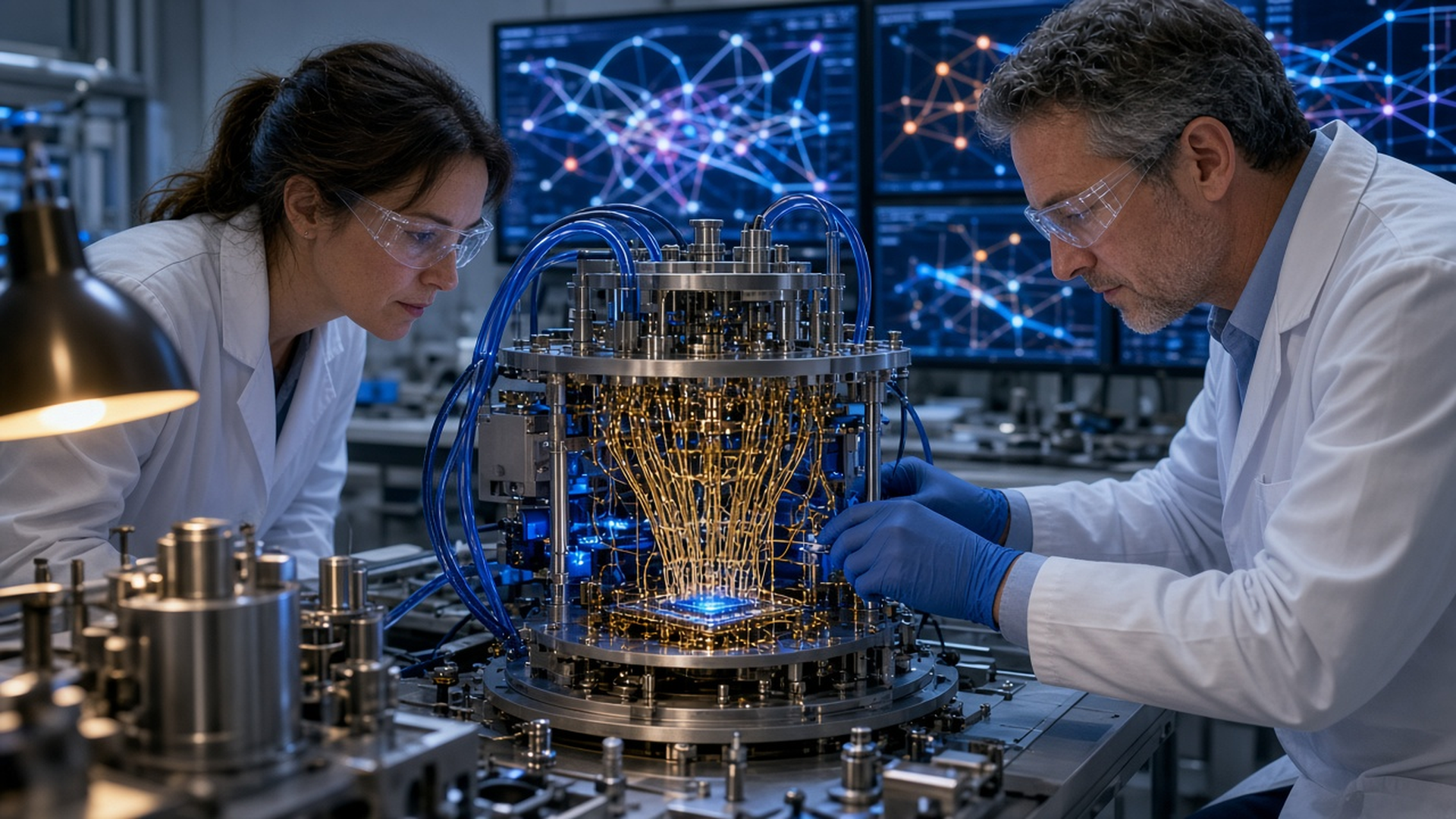
🔬 **Anthropic** on **October 16** said **Claude Mythos 5** autonomously redesigned eight foundational **quantum circuits** used in chemistry, optimization, simulation, and number theory, beating the best published designs on **seven** tasks when scored by automated evaluators.
The work, led by **Andi Gu** in Anthropic’s **STEM Fellows Program** with **Harvard** and **QuEra** collaborators, paired plain-language specs with a closed-loop scorer. The model wrote each circuit as **Python**, received correctness checks and feedback, and iterated without human steering between rounds. In seven cases, **Anthropic** reports both fewer **Toffoli gates** and fewer qubits than prior art; a **decoded quantum interferometry** decoder roughly **12×** fewer gates than a **Google Quantum AI** baseline.
One elliptic-curve point-addition run lasted **53 hours**, yielding a reversible **divsteps** modular-inversion design checked in **Lean**. A point on the new trade-off frontier uses **12%** more qubits but **17×** fewer gates than the smallest published circuit—a memory-for-runtime swap that expands what fault-tolerant hardware might afford.
The company posted results on **arXiv** alongside its research blog. The circuits are resource estimates, not yet demonstrated on hardware, but they signal that frontier **LLMs** can search algorithm structure—not just text—when verification is automated. For quantum and AI labs, evaluator-guided discovery may shorten years of hand tuning. ⚛️