OpenAI BioBasicsBench Tests AI Agents on 100 Wet-Lab Tasks
OpenAI unveiled BioBasicsBench with Ligo, a 100-task benchmark that grades AI agents on raw gels, plates, and instrument exports from everyday wet-lab
By AI World
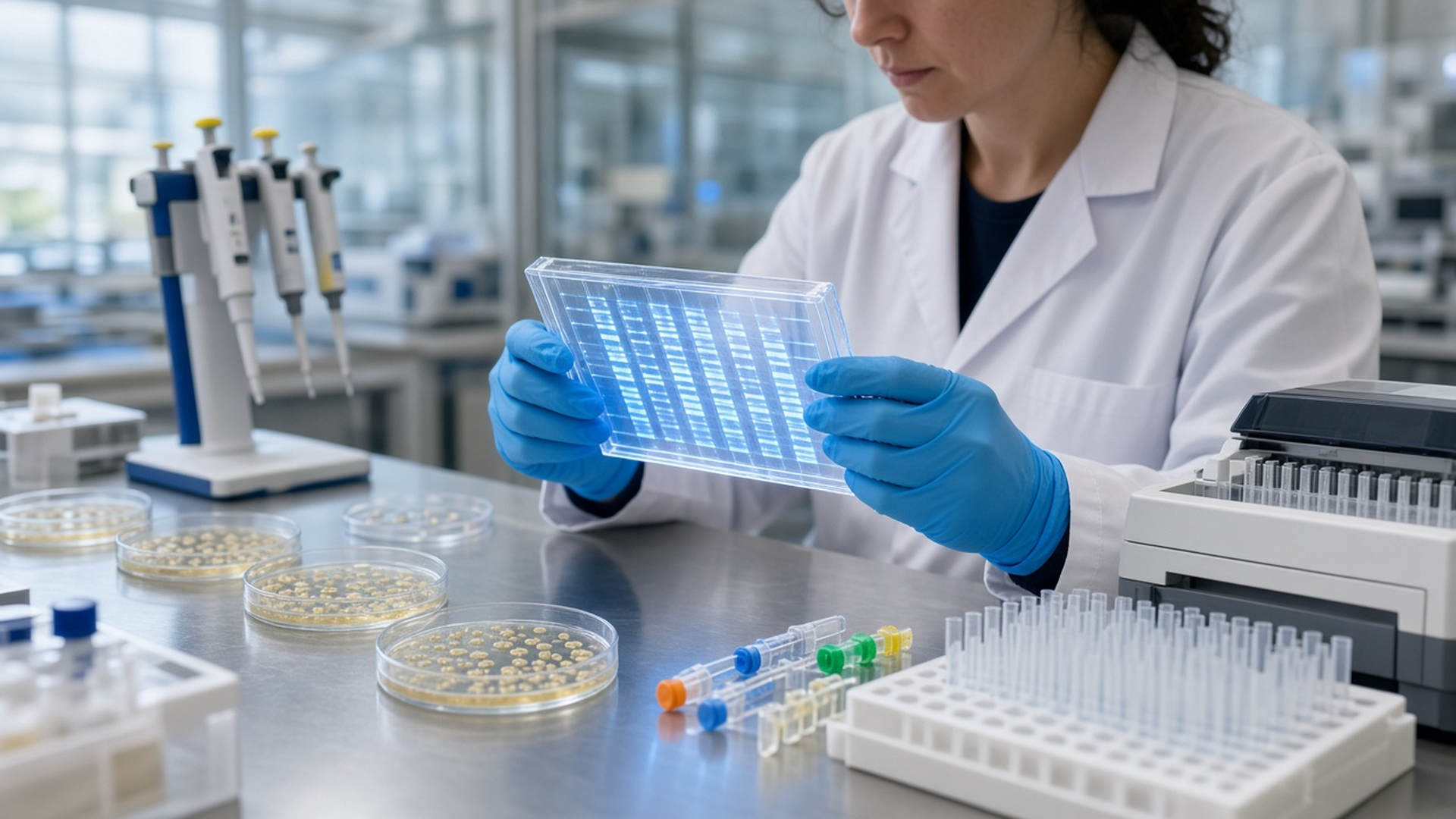
🧪 **OpenAI** on **Thursday** introduced **BioBasicsBench**, a **100-task** benchmark built with biotech firm **Ligo** to measure how AI agents handle routine wet-lab work—the kind of messy gels, colony plates, and instrument readouts bench scientists see every day, not the curated figures that dominate most academic benchmarks.
Each task asks models to interpret raw evidence, spot failed controls, and admit when data cannot support a claim. **OpenAI** tested seven models across **37** reasoning settings, running five attempts on every task for **18,500** graded results. At **xhigh** reasoning effort, **GPT-6 Astra** averaged **66.7%** of available rubric credit, up from **43.8%** for **GPT-5.6 Sol**, while using far fewer output tokens per task.
The gap matters because drug discovery and biology labs increasingly want agents that read notebooks and bench photos, not just summarize papers. **OpenAI** documented sharp gains in multimodal reading—**Astra** caught a mislabeled antibiotic control that fooled **GPT-5.6 Sol**—but also failure modes where assumptions override evidence, including wrong colony picks in PCR analysis and inflated plate counts.
The company framed **BioBasicsBench** as a yardstick for safer, more useful lab assistance and future biosafety review, not proof that models are ready to run benches alone. 🔬