Phil the Godwit Maps a 6,800-Mile Round Trip to Arctic Siberia
A six-gram solar tracker followed Phil from England's Wash to Siberia and back — the first full map of one bar-tailed godwit's East Atlantic Flyway migration.
By World
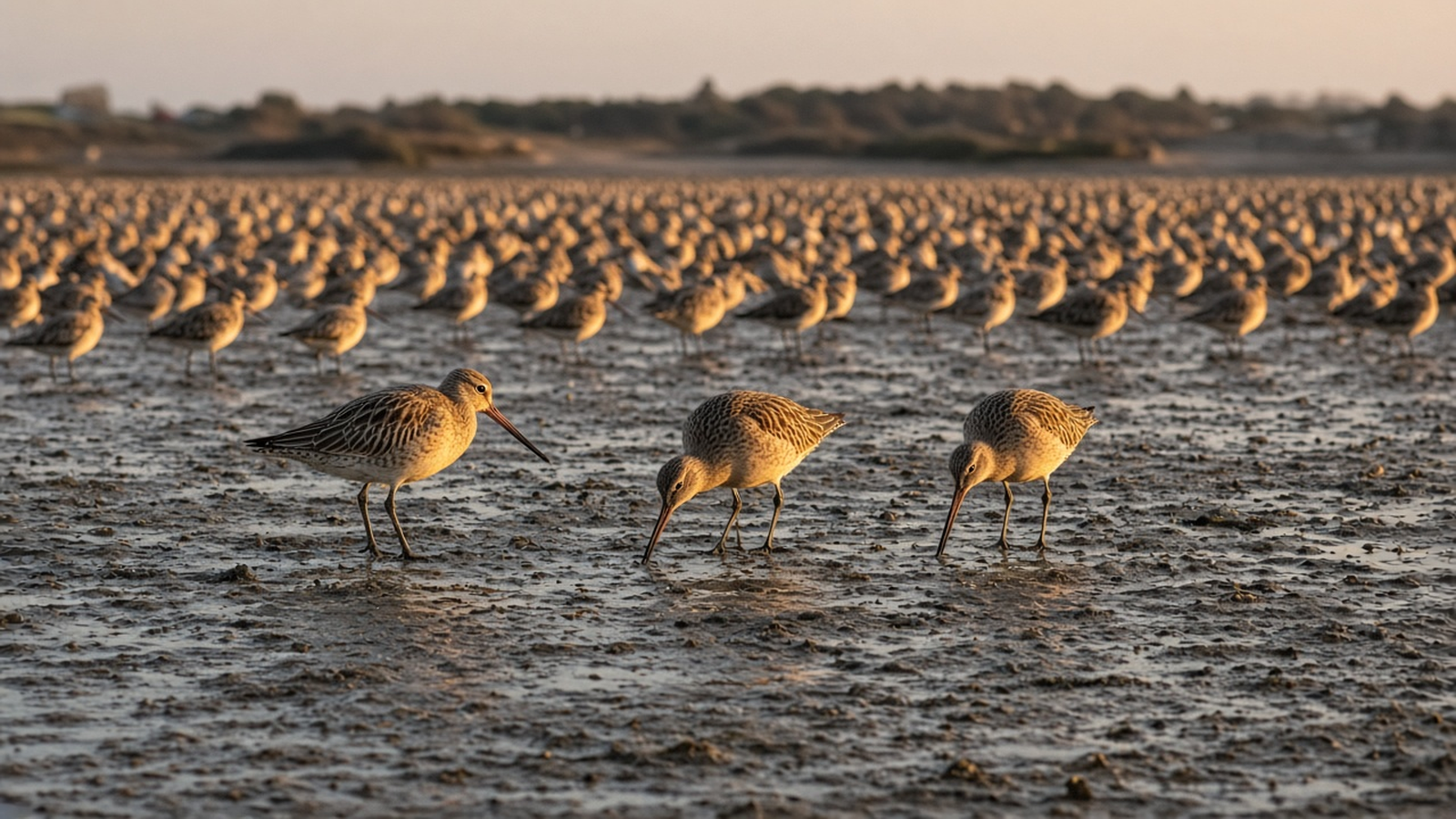
For decades, bar-tailed godwits vanished from radar between Britain and the Arctic. They are pigeon-sized waders celebrated as nature's longest-distance flyers — one subspecies once flew **8,425 miles** nonstop from Alaska to New Zealand — yet the exact paths of birds wintering on England's coast remained guesswork.
That changed in **2026**. In January, the **Wash Wader Research Group** fitted **Phil** — named for longtime leader **Phil Ireland** — with a **six-gram** solar-powered GPS backpack. Data transmitted through the year show a **6,800-mile** (roughly **10,950 km**) round trip: from **The Wash** in Norfolk to the **Taymyr Peninsula** in central Siberia and home again.
Phil staged through the **Wadden Sea** along the Netherlands, Germany, and Denmark in March, then pushed northeast into the Arctic in late May. On the return leg he crossed the **Arctic Ocean** to northern **Norway**, paused on three coastal islands, retraced the Wadden Sea service stations, and landed back on the Wash — a chain of wetlands thousands of miles apart.
The route matters because bar-tailed godwits do not live on one beach. They depend on the **East Atlantic Flyway**, a migratory motorway linking the Arctic, Europe, and Africa. Mudflats like **RSPB Snettisham**, where Phil now winters with thousands of knot and brent geese, are refueling stops — not endpoints.
**Dr Nigel Clark** of the Wash Wader Research Group says tracking proves those sites are connected: lose one link and endurance athletes starve mid-journey. Conservationists are campaigning to protect the entire east-coast wetland corridor, recently nominated as a potential **UNESCO World Heritage** site.
Phil's map is one bird — but it turns a famous species from myth into geography you can draw on a globe.